
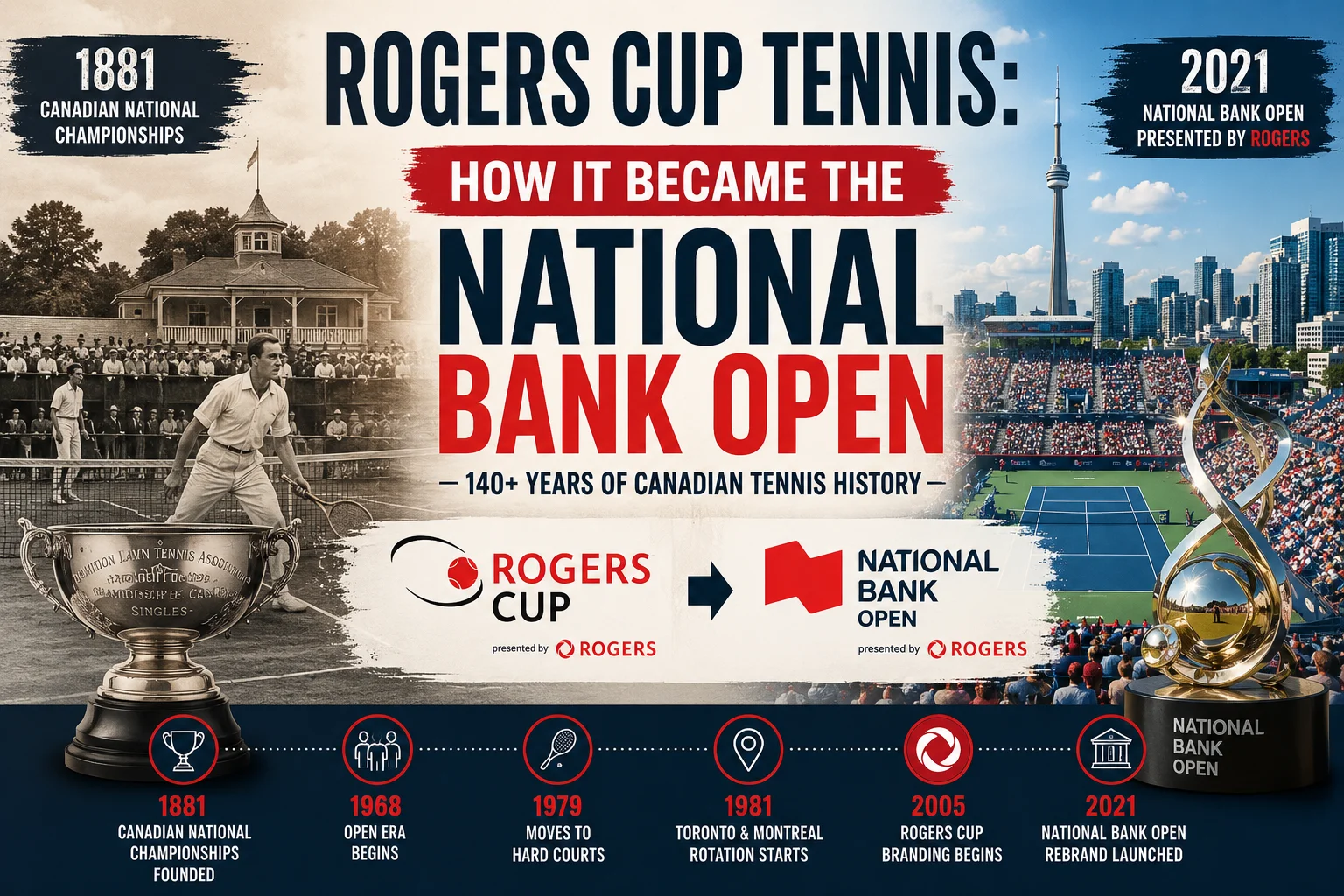
Rogers Cup Tennis: How It Became the National Bank Open
Founded in 1881, the Canadian Open is the second-oldest tennis tournament in the world after Wimbledon. Ask any Canadian tennis fan about the Rogers Cup and watch their face light up.
For two decades, Rogers Cup tennis was the sound of summer in Canada. Packed stadiums, World-class players, Unforgettable moments on hard courts in Toronto and Montreal. But today the tournament has a different name on the banner. The National Bank Open presented by Rogers. Same tournament. Same cities. Same passion. Just a fresh identity for a new era.
So how did one of the most iconic names in Canadian sports become something completely different? And why do millions of fans still call it the Rogers Cup? This is the full story. From a small grass court in 1881 to one of the biggest tennis events on the planet.
Quick Timeline of the Tournament Evolution:
| Year | Major Milestone |
|---|---|
| 1881 | Canadian National Championships founded |
| 1968 | Open Era begins |
| 1979 | Tournament moves to hard courts |
| 1981 | Toronto & Montreal rotation starts |
| 2005 | Rogers Cup branding officially begins |
| 2021 | National Bank Open rebrand launched |
Origins of the Canadian National Championships – 1881
Before Rogers Cup tennis existed, there was a small tournament on a grass court in Toronto. The year was 1881. Wimbledon had only been running four years. And Canada was already hosting what would become one of the longest running tennis events in the world. It started simple. No prize money. No sponsors. Just players competing for a silver cup at the Toronto Lawn Tennis Club. The first ever champion was Isidore F. Hellmuth, a local member who also helped organize the whole event.
Early milestones at a glance:
| Year | What Happened |
|---|---|
| 1881 | First tournament at Toronto Lawn Tennis Club |
| 1892 | First official women’s event added |
| 1968 | Open Era begins, professionals allowed |
| 1979 | Tournament moves to hard courts |
| 1981 | Alternating between Montreal and Toronto begins |
For 86 years it ran as a purely amateur event. Then 1968 changed everything. Professionals were finally allowed. Prize money was introduced. The world’s best players started showing up in Canada. The tournament was growing. The biggest transformation was still coming.
When the Tournament Became the Rogers Cup
The Rogers Cup name did not arrive overnight. It was built through years of sponsorship evolution. Through the 1970s, 1980s, and 1990s the tournament carried tobacco company names. Rothmans. Players International. Du Maurier. Each sponsor left their mark on Canadian tennis history. Then in 2001 everything changed.
Rogers Communications stepped in as title sponsor for the women’s event. By 2005 Rogers took over both the men’s and women’s tournaments and the Rogers Cup was officially born.
The sponsorship timeline:
| Years | Tournament Name |
|---|---|
| 1968-1969 | Canadian Open |
| 1970-1978 | Rothmans Canadian Open |
| 1979-1996 | Player’s International Canadian Open |
| 1997-2000 | du Maurier Open |
| 2001-2004 | Rogers AT&T Cup |
| 2005-2020 | Rogers Cup |
For 15 years the Rogers Cup name became synonymous with elite tennis in Canada. It was broadcast across North America. It attracted massive crowds. It became one of the most recognised stops on both the ATP and WTA tours. Canadian tennis fans grew up with this name. It felt permanent. But nothing in sport stays the same forever.
Toronto and Montreal – How the Hosting System Works
One of the most unique things about the Rogers Cup tennis was always the two city system. No other tournament in the world splits its event across two different cities the way Canada does.
Here is how it works:
- The men’s ATP tournament and women’s WTA tournament alternate between Toronto and Montreal every year
- In even numbered years men play in Montreal and women play in Toronto
- In odd numbered years that flips around
- Both tournaments run on the same dates simultaneously
2026 city split:
| Tour | City | Venue |
|---|---|---|
| ATP Men’s | Montreal | IGA Stadium |
| WTA Women’s | Toronto | Sobeys Stadium |
This system started in 1981 and has been running ever since. It gives both cities an equal share of the world’s best tennis. Montreal gets the men one year. Toronto gets them the next. Both fanbases stay invested. Both cities stay on the global tennis map.
IGA Stadium in Montreal and Sobeys Stadium in Toronto have both hosted legendary matches, unforgettable finals, and moments that defined careers. The two city system is not just a logistical arrangement. It is part of what makes Rogers Cup tennis and now the National Bank Open genuinely unique on the world tennis calendar. No other tournament does it this way.
Why Rogers Cup Changed Its Name
In 2021 Canadian tennis fans woke up to a new name on the banner. The Rogers Cup was gone. The National Bank Open presented by Rogers had arrived.
For many fans it felt strange. The Rogers Cup name had been part of Canadian summers for 15 years. It was iconic. It was familiar. Why change it?
The answer was straightforward. National Bank of Canada came on board as the new title sponsor. It was a major financial partnership that gave Tennis Canada the resources to grow the tournament further. National Bank took the naming rights while Rogers stayed on as a presenting sponsor, keeping their name in the title.
What changed and what stayed the same:
| Element | Changed | Stayed the Same |
|---|---|---|
| Title sponsor | Rogers to National Bank | Rogers still presenting sponsor |
| Tournament name | Rogers Cup to National Bank Open | Same event, same cities |
| Format | Slightly updated | Same hard court surface |
| Prestige | Rebranded | ATP 1000 and WTA 1000 status unchanged |
| Fan experience | Fresh identity | Same world class tennis |
One more important factor. The 2020 tournament was cancelled completely due to the COVID-19 pandemic. It was the first cancellation since World War II.
When the tournament returned in 2021 it came back with a new name, a new sponsor, and a fresh sense of purpose.
The Rogers Cup era was over. A new chapter had begun.
The Modern Era of the National Bank Open
The rebranding did not slow anything down. If anything it pushed the tournament forward.
The National Bank Open quickly established itself as one of the most exciting events on the summer tennis calendar. Bigger prize money. A larger 96 player draw. A new 12 day format giving players proper rest between matches.
What the modern tournament looks like:
| Feature | Detail |
|---|---|
| Men’s status | ATP Masters 1000 |
| Women’s status | WTA 1000 |
| Draw size | 96 players each draw |
| Format | 12 day tournament |
| Prize money | WTA over 7.4 million dollars in 2026 |
| Top seeds | Receive first round bye |
The ATP Masters 1000 and WTA 1000 status means this is the highest level of tennis below the four Grand Slams. The world’s best players are essentially required to show up. Missing this tournament means missing 1000 ranking points. Most top players cannot afford that risk.
The tournament also sits perfectly on the calendar as preparation for the US Open. Same hard court surface. Same August heat. Same physical demands. Players use Montreal and Toronto to sharpen their game before the final Grand Slam of the year.
Canadian tennis itself has grown dramatically in this modern era. Felix Auger-Aliassime and Victoria Mboko represent a golden generation of homegrown talent that Rogers Cup tennis helped inspire. The National Bank Open is not just carrying on the Rogers Cup legacy. It is building something even bigger.
Famous Champions in Rogers Cup Tennis History
The list of players who have won on Canadian soil reads like a hall of fame. During the Rogers Cup era and beyond, the biggest names in tennis made this tournament a priority every summer. And they delivered some of the most memorable matches in the sport’s history.
Men’s champions who defined the Rogers Cup era:
| Player | Titles at Canadian Open |
|---|---|
| Ivan Lendl | 6 titles (record holder) |
| Rafael Nadal | 2005, 2008, 2019 |
| Novak Djokovic | 2007, 2011, 2016 |
| Roger Federer | 2004, 2006 |
| Andy Murray | 2009, 2015 |
Women’s champions who lit up Toronto and Montreal:
| Player | Notable Win |
|---|---|
| Serena Williams | Multiple titles, dominant force |
| Simona Halep | Back to back titles 2016 and 2018 |
| Bianca Andreescu | 2019 wildcard victory on home soil |
| Victoria Mboko | 2025 champion, defeated Naomi Osaka |
Andreescu’s 2019 title remains one of the most emotional moments in Canadian sports history. A young Canadian wildcard defeating Serena Williams in Toronto in front of a home crowd that could barely contain itself.
Six years later Victoria Mboko added her name to that list, winning the 2025 women’s title in Montreal and continuing the tradition of Canadian players rising to the occasion on home soil. These moments did not happen at just any tournament. They happened at Rogers Cup tennis. They happened at the National Bank Open. They happened in Canada.
The Rogers Cup Legacy in Canadian Tennis
The Rogers Cup name may be gone from the banner. But its legacy lives on in every serve, every rally, and every roaring crowd at IGA Stadium and Sobeys Stadium. For 15 years Rogers Cup tennis did something remarkable. It took a tournament that was already over a century old and made it feel urgent, exciting, and unmissable every single August.
It introduced a generation of Canadian fans to world class tennis. It gave Felix Auger-Aliassime, Bianca Andreescu, and Victoria Mboko a stage to dream on. It showed the world that Canada was not just a stop on the tour. It was one of the best stops on the tour.
What the Rogers Cup gave Canadian tennis:
- A globally recognised brand that drew the world’s best players every summer
- Two iconic venues in Toronto and Montreal that became cathedrals of the sport
- Moments like Andreescu vs Serena in 2019 that transcended tennis and became part of Canadian sports history
- A fanbase that grew year after year, city after city
- A platform that inspired the next generation of Canadian champions
Today the National Bank Open carries all of that forward. Same passion. Same prestige. Same cities. New name. New era. If you grew up watching Rogers Cup tennis, this is still your tournament. It always will be. The name changed. The love for Canadian tennis never did.
FAQs
Conclusion
The story of Rogers Cup tennis is really the story of Canadian tennis itself. From a grass court in 1881 to sold-out stadiums in Montreal and Toronto, this tournament has seen it all. The name changed. The loyalty never did.
This year the National Bank Open returns for another unforgettable chapter. Explore schedules, players, tickets, and venues right here on canadianopentennis.com


